
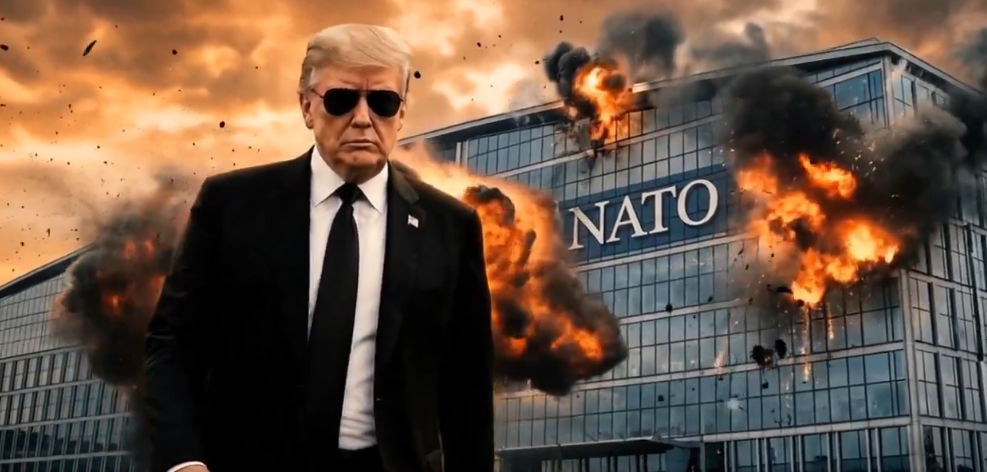
Web Desk: Divisions between the United States and its European allies have deepened sharply during the ongoing Iran war, placing NATO cohesion under one of its most serious pressures in decades.
Moreover, as US President Donald Trump calls for greater allied involvement, Washington has increasingly relied on European airspace, bases and logistical networks. However, several NATO members have resisted providing the level of cooperation sought by the White House.
The conflict, which erupted on February 28 following joint US and Israeli strikes on Iranian targets, has not only heightened tensions in West Asia but also exposed widening cracks in the transatlantic alliance.
At the same time, a number of European countries have imposed limits on US military activity linked to the conflict.
Spain has taken one of the strongest positions, closing its airspace to US aircraft involved in the war and blocking access to bases on its territory.
Similarly, Italy denied landing permissions for US planes at bases in Sicily, including Sigonella, after determining their missions were tied to combat operations. Officials cited procedural requirements and the nature of the missions as key factors behind the decision.
Meanwhile, France has drawn a distinction between support and combat roles. While allowing refuelling and logistical assistance, Paris has refused to facilitate offensive operations.
Portugal has also limited access to its Lajes Air Base in the Azores strictly to transit and refuelling within existing agreements.
In Eastern Europe, Poland rejected US suggestions to redeploy Patriot air defence systems to West Asia, citing national security concerns tied to regional tensions.
However, some countries have maintained limited cooperation. Romania has permitted logistical use of its facilities, with Prime Minister Ilie Bolojan warning that a political split could have far-reaching consequences.
Germany has adopted a more nuanced stance. Chancellor Friedrich Merz has allowed continued US access to Ramstein air base under existing agreements, while also voicing criticism of Washington’s approach.
However, the restrained European response has drawn sharp criticism from Washington.
Trump publicly rebuked several allies, singling out France for restricting certain military flights and warning that the United States would remember the lack of support.
In addition, he criticised countries affected by energy disruptions following the closure of the Strait of Hormuz, urging them to rely less on US support and take greater responsibility for securing resources.
US Secretary of State Marco Rubio echoed these concerns, describing the response from NATO allies as disappointing. He suggested Washington may reassess the alliance after the conflict, questioning whether it remains mutually beneficial.
At the same time, Rubio indicated that diplomatic contacts with Tehran are ongoing and said the conflict could move toward a conclusion, though not immediately.
Meanwhile, European governments have pointed to several factors behind their cautious approach.
One major issue is legality. Leaders such as Spanish Prime Minister Pedro Sánchez have described the strikes as lacking a clear basis under international law, influencing broader policy decisions across the continent.
Domestic political considerations have also played a role. Public opinion in many countries remains wary of deeper military involvement, prompting governments to balance alliance commitments with voter sentiment.
In addition, economic pressures have intensified following disruptions in global energy supplies linked to tensions around the Strait of Hormuz. Rising oil and gas prices have added to inflation concerns, further discouraging escalation.
As a result, US military operations have faced growing logistical hurdles.
Restrictions on airspace across southern Europe have forced American aircraft to take longer routes, increasing operational strain and fuel demands.
These challenges have been underscored by incidents such as the crash of a US refuelling aircraft in Iraq, highlighting the risks associated with extended missions and limited infrastructure access.
Nevertheless, some allies, including the United Kingdom, have shifted positions slightly, allowing limited base use for defensive purposes after initial hesitation.
Ultimately, the current dispute reflects a broader shift in US foreign policy under Trump’s second term.
Washington has pushed for allies to shoulder more responsibility for their own defence, while reducing its commitments in certain regions and prioritising strategic competition with China and Iran.
This approach has already strained relations, including disputes over trade, security priorities and even territorial interests such as renewed US attention toward Greenland.
In response, European policymakers have increasingly discussed the need for greater strategic autonomy, including the possibility of a more independent security framework within NATO.
As the conflict enters its fifth week, uncertainty continues to surround the future of the transatlantic alliance, with both sides navigating a relationship under mounting pressure.
Read more: Ban on women’s access to UN facilities hits health and relief efforts in Afghanistan