
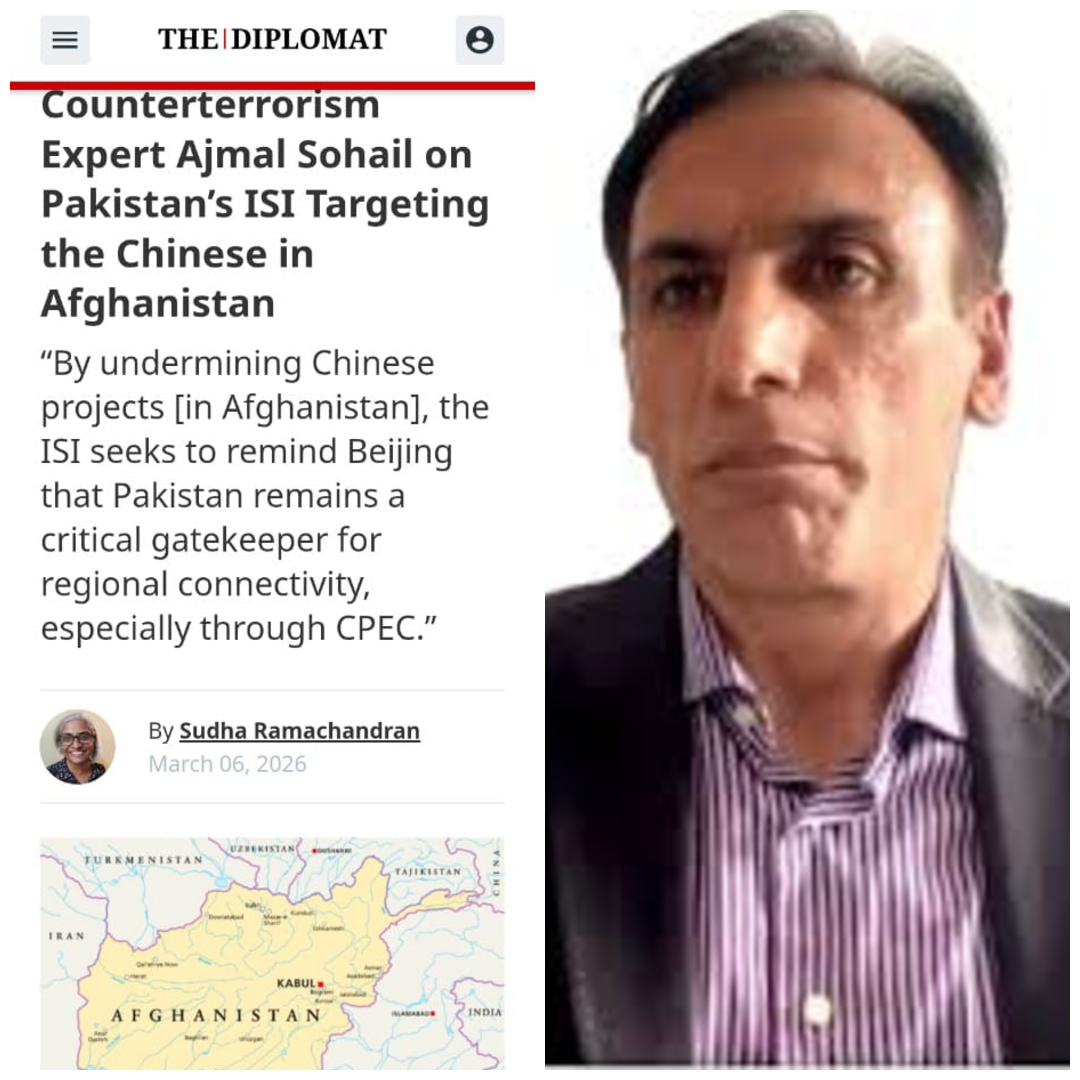
Web Desk: A recent interview in the South Asia publication of The Diplomat has drawn scrutiny among regional observers after an Afghan political figure cited as an “intelligence analyst” accused Pakistan of covertly arming terrorists targeting Chinese interests in Afghanistan.
The interview, conducted by South Asia editor Sudha Ramachandran, quoted Afghan political economist Ajmal Sohail alleging that Pakistan’s Inter-Services Intelligence (ISI) supplied weapons to militant groups operating in Afghanistan’s Wakhan Corridor.
However, the claims rely largely on Sohail’s assertions and on an unverified Taliban statement, with no independent evidence presented to support the accusations against Pakistan.
Ramachandran introduced Sohail as an “Afghan intelligence analyst and counterterrorism expert.” Yet the interview did not disclose his political affiliations or past advocacy for closer Afghanistan–Israel ties.
Sohail is the founder of the Afghan Liberal Party and has previously promoted engagement between Afghanistan and Israel. In an earlier interview with the Israeli foreign policy think tank Mitvim the Israeli Institute for Regional Foreign Policies, Sohail openly argued that Afghans should explore economic and political cooperation with Israel.
In that discussion, he stated that “Afghanistan is not opposed to business or trade with Israel” and suggested that both sides pursue engagement quietly while expanding cooperation in areas such as banking, mining and development.
Such remarks indicate an unusual alignment with Israeli policy interests in a region where Israel has historically had limited political presence.
In the same interview with the Israeli institute, Sohail presented himself as an advocate of building ties between Afghan political actors and Israeli policymakers.
The comments have led some observers to question whether Sohail’s political activity represents a broader effort to cultivate pro-Israel networks within Afghan political circles.
The Diplomat interview focused heavily on allegations that Pakistani intelligence was arming anti-Taliban groups and militants targeting Chinese investment projects in Afghanistan.
Sohail claimed that Taliban intelligence intercepted a shipment of hundreds of weapons and thousands of rounds of ammunition allegedly destined for militant groups operating near the Wakhan Corridor, a narrow strip of Afghan territory bordering China, Tajikistan and Pakistan.
Yet the report relied primarily on the Taliban’s own assertion regarding the seizure. No independent confirmation from international monitors, Chinese officials, or neutral observers accompanied the claim.
Pakistan’s relationship with militant groups in the region has long been the subject of international scrutiny. However, Islamabad has also suffered repeated attacks from militant organisations including Tehreek-e-Taliban Pakistan (TTP) and Islamic State Khorasan Province (ISKP).
In recent months, Pakistan has launched cross-border airstrikes against suspected militant camps inside Afghanistan following deadly attacks in Bajaur, Bannu and Islamabad.
Security analysts say the evolving relationship between Pakistan, the Afghan Taliban and transnational terrorist groups reflects a complex regional security environment shaped by competing interests of multiple states and non-state actors.
The controversy surrounding the interview underscores the growing role of media narratives and competing information campaigns in shaping perceptions of regional security.
While Sohail portrayed Pakistan as attempting to undermine Chinese projects in Afghanistan, critics argue that the absence of corroborating evidence and the omission of his political affiliations raise questions about the framing of the story.
This highlights how geopolitical rivalries increasingly play out through think-tank publications, interviews and media platforms often blurring the line between analysis and advocacy.
Read more: Kabul scandal: Pakistan Embassy denies role in visa black market