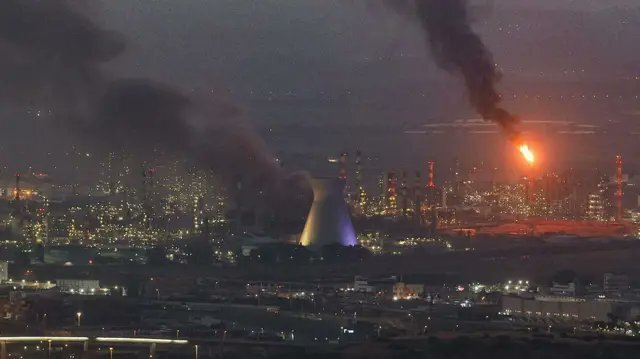
Web Desk: Iran said it carried out a retaliatory missile strike on an oil refinery in Israel’s northern port city of Haifa, as the rapidly escalating conflict between Tehran, Israel and the United States spread across the Middle East and beyond.
Iran’s Islamic Revolutionary Guard Corps (IRGC) said it targeted the Haifa facility with Khyber-Shakan missiles in response to Israeli strikes on Iranian oil infrastructure in Tehran.
The attack marked one of several Iranian retaliatory actions following waves of US and Israeli strikes on Iranian military and energy facilities in recent days.
In a statement, the IRGC said the missile attack targeted an Israeli refinery in Haifa after Israeli forces struck an oil facility in Tehran earlier in the conflict.
Israeli authorities did not immediately provide details on the extent of the damage, but Iranian officials said the operation was intended as a direct response to what they described as attacks on the country’s energy infrastructure.
The exchange represents a sharp escalation in hostilities between the long-time regional rivals, with energy facilities increasingly becoming targets on both sides.
Meanwhile, Iranian drones also struck civilian infrastructure in the Gulf, including a water desalination plant in Bahrain, causing material damage, according to Government of Bahrain.
The attack followed a broader wave of Iranian missile and drone launches across Gulf Arab states, including Bahrain, the United Arab Emirates and Kuwait, as Tehran widened its retaliation beyond Israel.
Regional authorities said several projectiles were intercepted, although some infrastructure damage and casualties were reported in parts of the Gulf.
The conflict also appeared to spill into Europe, where an attack was reported near the U.S. embassy in Norway. Authorities there launched an investigation while increasing security around diplomatic missions.
Officials have not yet publicly attributed responsibility, but the incident came amid rising tensions linked to the widening Middle East conflict.
The Iranian attacks followed days of intense U.S. and Israeli airstrikes on targets across Iran, including oil depots, military bases and infrastructure in Tehran and other cities.
The strikes formed part of a broader campaign that Western officials say aims to degrade Iran’s military capabilities and prevent further regional attacks.
Explosions and fires have been reported across several Iranian cities as the aerial campaign continues.
The fighting has taken a heavy toll inside Iran. According to data cited by Al Jazeera, at least 1,332 people have been killed in Iran since the start of the US and Israeli attacks, with hundreds more injured.
The casualties include civilians as well as military personnel, with one of the deadliest incidents reported in the southeastern city of Minab where a strike hit a school during the bombardment.
Iran has launched hundreds of missiles and drones during the first days of hostilities, targeting Israeli sites and U.S. military positions across the region, according to military officials.
Analysts warn the conflict is rapidly expanding into a broader regional confrontation, with attacks now reported across multiple countries and global powers urging restraint.
The international community has called for urgent diplomatic efforts to prevent further escalation, as energy markets and security conditions across the Middle East remain increasingly volatile.
Read more: Despite bombing, thousands of Iranians took to streets expressing solidarity with the govt