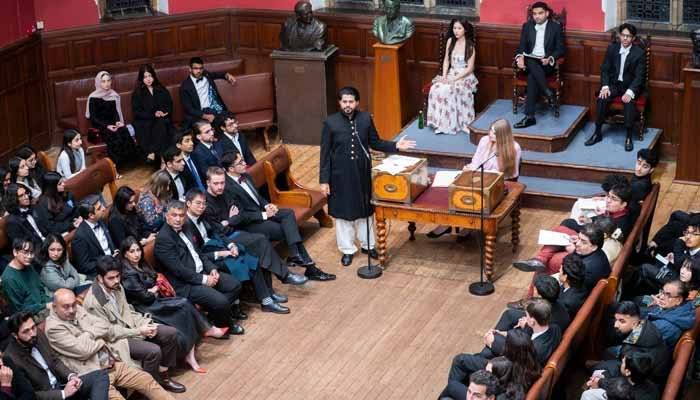
Three Pakistani students at Oxford University defeated their Indian counterparts in a highly watched debate on India’s national security policy, which they argued is used to create hate against Pakistan for political gain.
In the Oxford Union debate, India replaced its originally announced high-profile team with a new panel consisting of J Sai Deepak, Pandit Satish Sharma, and Deorchan Banerjee. They faced Pakistani students Moosa Harraj, Israr Khan Kakar, and Ahmed Nawaz Khan, who won with strong logic and arguments. Originally, India had planned to field former Army Chief General (retd) MM Naravane, former law minister Dr Subramanian Swamy, and former Rajasthan deputy chief minister Sachin Pilot. Pakistan’s side was expected to include Hina Rabbani Khar, General (retd) Zubair Mahmood Hayat, and Dr Mohammad Faisal.
The Oxford Union, one of the world’s most famous debating platforms, hosted the debate on the motion: “This House Believes India’s Policy Towards Pakistan is a Populist Strategy Sold as Security Policy.” The Pakistani speakers won by a large margin, securing 160 votes against India’s 51.
The debate attracted strong interest from students, diplomats, and South Asia experts, especially after the controversy over the withdrawal of original speakers. Despite concerns, the Oxford Union continued with the event, which ended with one of the biggest winning margins of the academic year.
Moosa Harraj opened the debate by arguing that India increasingly shapes its Pakistan policy based on election gains rather than security needs. He said India uses anti-Pakistan sentiments as a political tool, especially before elections. He also pointed out India’s use of water and hydro-politics to pressure Pakistan, calling it a biased strategy focused more on politics than real security concerns.
Israr Khan Kakar spoke next, highlighting how exclusionary domestic policies, especially against minorities like Muslims, influence India’s approach toward Pakistan. He said that Prime Minister Narendra Modi’s policies reflect a Hindutva-driven agenda that affects both internal and external relations. He warned that such politics can quickly increase regional tensions. Kakar added that Pakistan has the capability to respond to aggression but has always acted responsibly as a nuclear state. He also accused India of backing militant proxies, including in Balochistan, and noted that Pakistan remains one of the biggest victims of terrorism.
In his closing argument, Ahmed Nawaz Khan focused on Pakistan’s progress and resilience. He said Pakistan has improved its security, governance, and diplomacy and continues to seek regional stability despite hostile policies. He argued that the narrative of Pakistan as a destabilising actor is outdated.
Before the debate, speculation grew after news spread that Indian speakers had withdrawn. Some feared the debate might be cancelled, but the Oxford Union confirmed it would go ahead with replacement speakers while maintaining fairness.
The event drew a full house, and the final vote clearly showed strong support for the argument that India’s policy towards Pakistan is largely influenced by domestic populist politics rather than genuine security goals.