


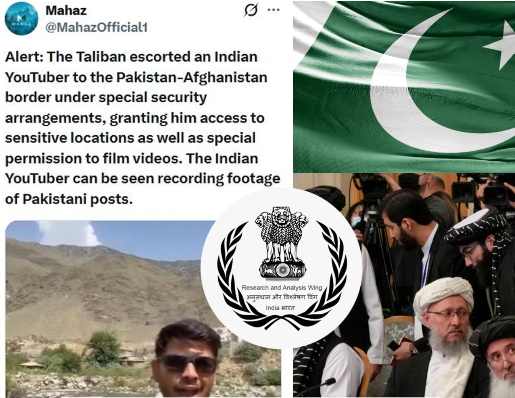
Web Desk: An Indian travel vlogger’s recent visit to Afghanistan has triggered a political and security debate in Pakistan, after claims emerged that he received extensive access to areas near the Pakistan-Afghanistan border while producing travel content.
Critics have questioned how the vlogger was able to visit sensitive locations and film in areas close to Pakistani military positions, arguing that the access warrants scrutiny amid continuing tensions between Islamabad and Kabul.
However, allegations that the vlogger was acting on behalf of India’s intelligence agency or that his trip formed part of an organised operation against Pakistan have not been independently verified.
The Indian content creator has been documenting his travels in Afghanistan, including locations close to the Pakistan border.
According to critics, the footage shows the vlogger receiving security escorts and visiting areas that would ordinarily be considered sensitive because of their proximity to the frontier.
The circumstances surrounding the access have fueled speculation in Pakistan about whether Afghan authorities granted the visitor unusual privileges.
There has been no independent evidence presented, however, establishing that the trip was coordinated by Indian intelligence authorities.
The reported access has become particularly controversial because of the security environment along the Afghanistan-Pakistan frontier.
Pakistan has repeatedly accused militant groups based in Afghanistan of launching attacks against Pakistani targets, while Afghan Taliban authorities have rejected allegations that they allow their territory to be used for attacks against neighboring countries.
Against this backdrop, footage of a foreign visitor operating near the border has prompted concerns over the possible collection or publication of information about military installations and border infrastructure.
Whether the material poses any genuine security risk would depend on the locations filmed, the information captured and the circumstances under which the footage was obtained.
The controversy has also revived debate over India’s relationship with Afghanistan’s Taliban authorities.
Pakistan has long expressed concern about India’s engagement with Kabul, particularly in the context of security developments along the western border.
Critics have described the vlogger’s visit as evidence of closer coordination between India and the Taliban. However, the visit alone does not establish an intelligence or military partnership.
Likewise, claims that India has financed the vlogger’s trip through its intelligence agency remain unsubstantiated in the information available.
The controversy comes as Pakistan continues to focus on militant activity originating from Afghan territory.
Islamabad has repeatedly called on Kabul to prevent armed groups from using Afghanistan as a base for attacks inside Pakistan. Afghan authorities have disputed Pakistan’s accusations and have urged Islamabad to address its own security concerns through bilateral mechanisms.
The issue has contributed to strained relations between the two neighbors, with border clashes and diplomatic disputes adding to existing tensions.
Consequently, any reported access by a foreign visitor to sensitive frontier locations is likely to attract heightened attention in Pakistan.
While the vlogger’s visit and reported access have generated strong reactions, claims of an organized India-Taliban operation against Pakistan should be treated as allegations unless supported by independent evidence.
The available information does not establish that the traveler was working for India’s Research and Analysis Wing, commonly known as RAW, or that the Taliban provided access specifically to facilitate intelligence gathering.
The episode nonetheless highlights the sensitivity surrounding foreign visitors operating near the Afghanistan-Pakistan border and the extent to which travel content from the region can quickly become part of a wider geopolitical dispute.
Read more: Journalism or vulgarity? BBC chasing views with controversial content aimed at Pakistan