
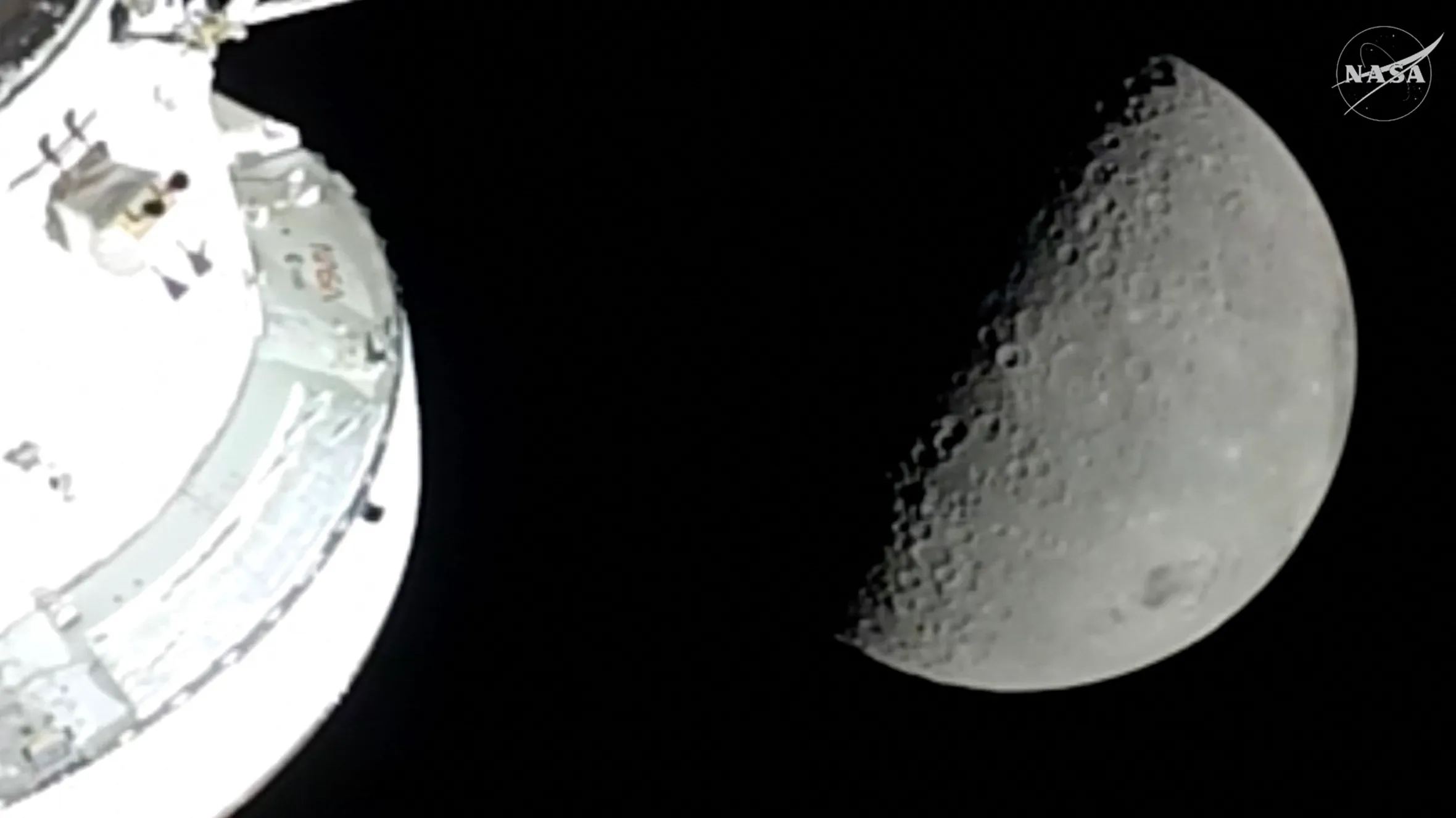
Web Desk: The four-member crew of NASA’s Artemis II mission made history today by successfully completing a lunar flyby aboard the Orion spacecraft, marking the furthest human journey from Earth to date. During the seven-hour maneuver, the astronauts observed various lunar surface features and captured high-resolution imagery of the moon’s terrain.
NASA confirmed that Artemis II has officially become the first crewed mission to travel such a vast distance from Earth. Communication with the spacecraft briefly ceased as Orion passed behind the far side of the moon, a scheduled blackout that lasted approximately 40 minutes. Once the craft emerged from the lunar shadow, mission control successfully re-established the signal.
Following the milestone, President Donald Trump held a telephonic conversation with the crew from the White House. He congratulated the astronauts on their successful orbit and expressed that the American people eagerly await their safe return. During the call, the President invited the crew to the Oval Office to collect their autographs and reminded them of his administration’s role in establishing the U.S. Space Force during his first term.
According to NASA flight data, the crew reached a point within 4,067 miles of the lunar surface at their closest approach. This trajectory allowed the astronauts to observe uncharted regions of the moon’s far side, providing a perspective that even the Apollo mission crews could not achieve due to differing flight paths. At its farthest point, the Orion spacecraft reached a distance of more than 252,000 miles from Earth, officially breaking the long-standing record held by the Apollo 13 mission.
The mission began Wednesday with a launch from the Kennedy Space Center at Cape Canaveral, Florida. After spending 25 hours orbiting Earth, the Orion spacecraft performed a trans-lunar injection on Thursday evening. By Friday morning, the vessel entered the lunar sphere of influence, where the moon’s gravity becomes the primary force acting upon the ship.
The crew is currently on its return trajectory and expects to conclude the historic journey with a splashdown in the Pacific Ocean on Friday evening. Officials noted that the data collected during this mission will prove vital for future lunar landings and the eventual goal of human exploration on Mars.
Read more: Countdown begins for a historic NASA moon mission after 53 years