
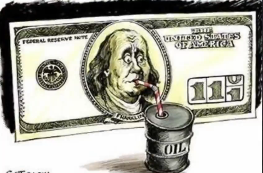
Web Desk: A decades-old financial arrangement known as Petrodollar that helped anchor global markets is showing signs of strain as conflict involving the United States, Israel and Iran disrupts both oil flows and investment patterns tied to the dollar.
For nearly half a century, a tacit understanding between Washington and Gulf producers underpinned global stability. The framework, shaped in the 1970s under then-US Secretary of State Henry Kissinger, saw oil exports priced in dollars, with surplus revenues reinvested into US government debt. In return, the United States provided security assurances and helped maintain a predictable global system.
As a result, energy-importing nations paid for oil in dollars, Gulf economies accumulated large reserves, and those funds flowed back into US Treasuries. The cycle reinforced the dollar’s dominance while helping keep American borrowing costs relatively low.
However, the current conflict has disrupted this balance from multiple directions.
On the demand side, recent weeks have seen foreign central banks reduce their holdings of US Treasuries. Data from the Federal Reserve Bank of New York shows a notable decline in custodial holdings, reaching their lowest levels in more than a decade.
At the same time, yields on benchmark 10-year US government bonds have risen sharply, defying the typical pattern seen during global crises when investors usually seek safety in Treasuries. Analysts at Bank of America noted that official sector institutions have turned into net sellers.
This shift reflects mounting pressure on oil-importing economies. Countries such as Turkey, India and Thailand are grappling with higher crude prices alongside weakening currencies. To stabilise exchange rates and limit domestic inflation, central banks have intervened by selling dollar-denominated assets primarily US Treasuries to access liquidity.
Unlike previous shocks, such as the market turmoil during the COVID-19 pandemic, where heavy selling was brief and quickly reversed, the current trend has shown greater persistence.
Meanwhile, supply-side disruptions are compounding the problem. The closure of the strategically vital Strait of Hormuz has significantly curtailed oil exports from key Gulf producers.
Major exporters including Kuwait, Iraq, Saudi Arabia and the United Arab Emirates have sharply reduced output, with alternative export routes unable to compensate for the lost capacity. These limited channels also face heightened security risks.
In addition, Qatar has halted some liquefied natural gas shipments following damage to key infrastructure, further constraining energy flows from the region.
As a result, Gulf economies are earning less from energy exports at a time when they are increasing spending on defense. This has disrupted their ability to recycle surplus revenues into global financial markets, including US Treasuries.
The breakdown affects both pillars of the traditional system: the generation of dollar revenues and their reinvestment. With reduced income and rising expenditures, Gulf states are reassessing overseas investment commitments, including those linked to the United States.
Sovereign wealth funds across the region, long considered major investors in US assets, are now reviewing their strategies amid heightened uncertainty.
At the same time, broader structural trends are adding to the shift. Foreign ownership of U.S. government debt has been declining for years, while central banks have increasingly diversified reserves into assets such as gold.
Despite the turbulence, analysts say US Treasuries remain unmatched in terms of liquidity and scale. However, the perception of these assets as an unquestioned safe haven is being tested.
Historically, global crises drove investors toward US debt, reinforcing its status as a refuge. But the current conflict is altering that dynamic, as the United States is directly involved rather than acting as a distant stabilising force.
This evolving role is prompting investors to reassess risk, particularly as rising fiscal pressures add to concerns about US debt sustainability.
While few expect a wholesale shift away from US Treasuries, the ongoing conflict is accelerating changes that were already underway. What was once a stable and predictable financial loop is now facing increasing strain.
The arrangement forged in the 1970s endured multiple global shocks, from geopolitical conflicts to financial crises. Yet the present situation suggests that shifting political realities may now be reshaping the financial architecture that followed.
Read more: Netanyahu urges Trump to reject Iran ceasefire as talks gain momentum