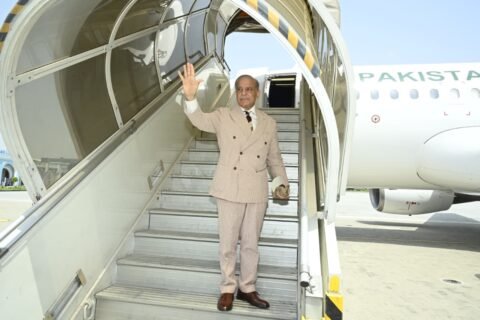
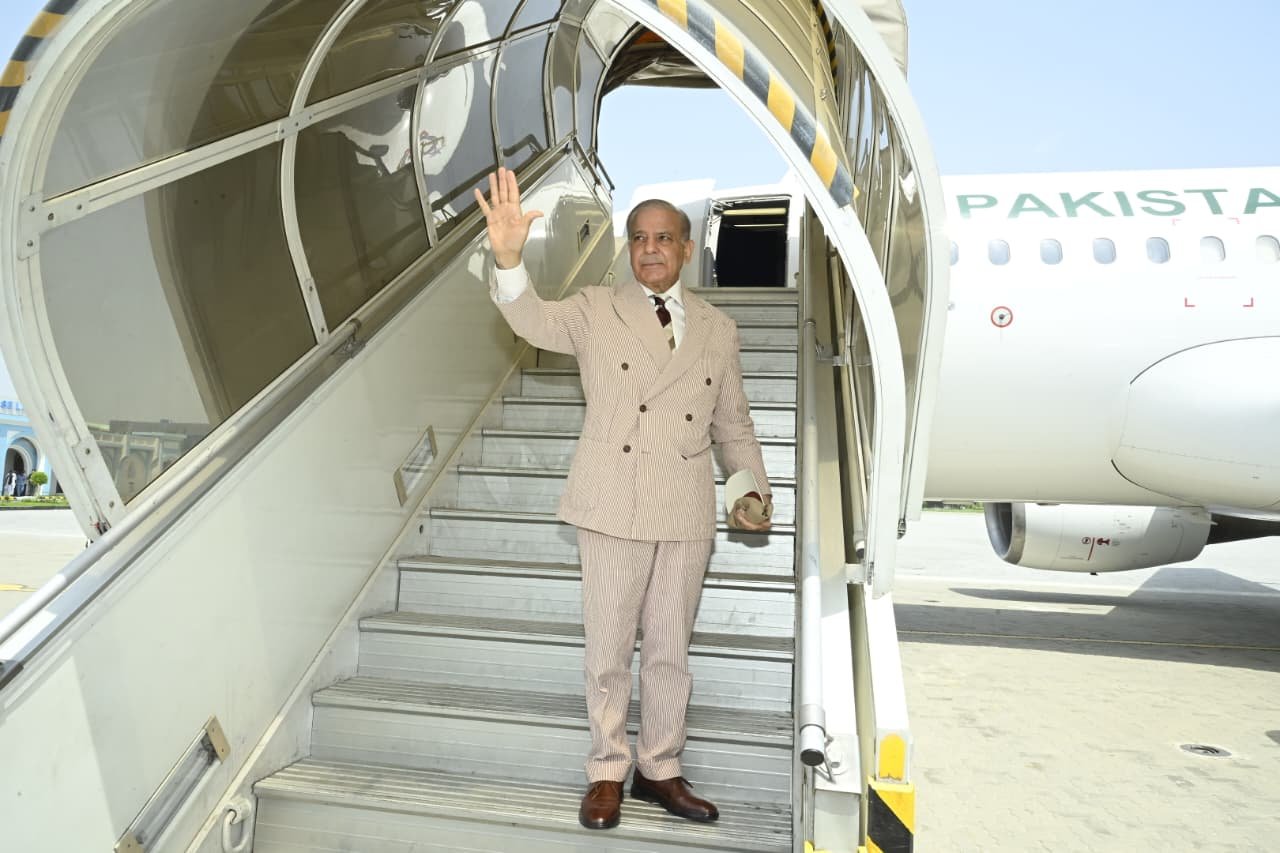
Web Desk: Prime Minister Shehbaz Sharif arrived in Kyrgyzstan on Monday for a three-day visit aimed at advancing Pakistan’s regional priorities, strengthening bilateral ties and engaging with leaders attending the Shanghai Cooperation Organisation summit.
Shehbaz is visiting Kyrgyzstan from Aug. 31 to Sept. 2 at the invitation of President Sadyr Zhaparov, according to the Prime Minister’s Office.
The visit coincides with the SCO’s annual summit in Bishkek, where leaders from major regional powers are gathering as the organisation marks 25 years since its establishment.
Pakistan’s delegation includes Deputy Prime Minister and Foreign Minister Ishaq Dar, Commerce Minister Jam Kamal Khan, Communications Minister Abdul Aleem Khan, Information Minister Ataullah Tarar and senior officials.
Shehbaz is scheduled to address the SCO Plus Summit and outline Pakistan’s position on regional and international developments.
He will also assume Pakistan’s chairmanship of the SCO Council of Heads of State for the 2026-27 period, giving Islamabad an opportunity to shape the organisation’s agenda during the coming year.
Pakistan is expected to use its SCO platform to push for stronger regional connectivity, expanded trade and investment, improved economic cooperation and greater collaboration on security challenges.
Islamabad also wants the organisation to strengthen links among member states in transport, energy and digital connectivity, areas it sees as essential for unlocking greater economic integration across Central and South Asia.
Security cooperation remains a central component of the SCO agenda, and Pakistan is expected to highlight the need for collective efforts against terrorism, extremism and other transnational security threats.
At the same time, Islamabad is likely to emphasise economic diplomacy, particularly measures that can facilitate trade and investment among SCO members.
Pakistan has repeatedly promoted its geographic position as a potential bridge connecting Central Asia with South Asia and the Arabian Sea. During its chairmanship, it is expected to advocate initiatives that can improve regional transport and commercial links.
The summit also comes amid heightened geopolitical and economic tensions, giving Pakistan an opportunity to engage with competing regional powers within a multilateral framework.
Beyond the formal SCO proceedings, Shehbaz is expected to hold a series of bilateral meetings with participating leaders.
The talks are likely to provide an opportunity to discuss trade, investment, energy cooperation, regional connectivity and security issues, while also addressing developments of mutual interest.
The prime minister will also attend the opening ceremony of the World Nomad Games in Bishkek on Aug. 31.
The gathering brings together senior leaders from across the region, including Russian President Vladimir Putin, Chinese President Xi Jinping, Indian Prime Minister Narendra Modi and Iranian President Masoud Pezeshkian, according to the summit programme provided.
Turkish President Recep Tayyip Erdogan is also expected to attend as a representative of an SCO dialogue partner.
The participation of these leaders creates opportunities for Islamabad to pursue parallel diplomatic engagements beyond the main summit agenda.
Pakistan’s engagement with China is expected to remain a key element of its SCO diplomacy, particularly around investment, infrastructure, connectivity and the expansion of economic cooperation.
Islamabad also maintains close strategic and economic ties with Russia and has sought greater cooperation in areas including energy, trade and regional connectivity.
Central Asian states are another priority for Pakistan, with Islamabad seeking to expand commercial links and improve access to regional markets through road, rail and energy projects.
The SCO provides a platform for Pakistan to pursue these interests collectively while maintaining direct engagement with individual member states.
On Sept. 2, Shehbaz is scheduled to hold talks with President Zhaparov on the full range of Pakistan-Kyrgyzstan relations.
The two leaders are expected to review bilateral cooperation and explore ways to expand economic and people-to-people links.
Trade and investment, energy, regional connectivity, education and tourism are expected to feature prominently in the discussions.
The two sides will also exchange views on regional and international developments and cooperation through regional and multilateral organisations.
Pakistan and Kyrgyzstan describe their relationship as rooted in shared cultural and religious ties and a common interest in greater regional connectivity and prosperity.
Islamabad sees the visit as an opportunity to translate recent high-level diplomatic exchanges into practical cooperation.
The Bishkek summit is taking place as the SCO seeks to deepen cooperation among a diverse group of countries spanning Asia and beyond.
The organisation has traditionally focused on regional security and economic cooperation. However, its meetings have increasingly become important diplomatic forums for major powers seeking to promote closer ties and advocate a more multipolar international order.
The SCO now includes 10 permanent members and a wider group of dialogue partners, giving it significant demographic and economic weight.
Its members account for a large share of the world’s population and global economic output, although political differences among them prevent the organisation from functioning as a conventional alliance.
For Pakistan, the Bishkek summit offers an opportunity to combine multilateral diplomacy with targeted bilateral engagement.
By taking over the SCO’s rotating chairmanship, Islamabad will have a year to promote its priorities on regional connectivity, economic cooperation and collective security.
The success of that effort will depend on Pakistan’s ability to build consensus among members with competing strategic interests while converting summit-level commitments into practical projects.
Shehbaz’s visit is therefore expected to serve two parallel objectives: strengthening Pakistan’s relationships with individual regional powers and positioning Islamabad as an active participant in shaping the SCO’s agenda over the coming year.
Read more: New provinces? Citizens from major cities speak out