
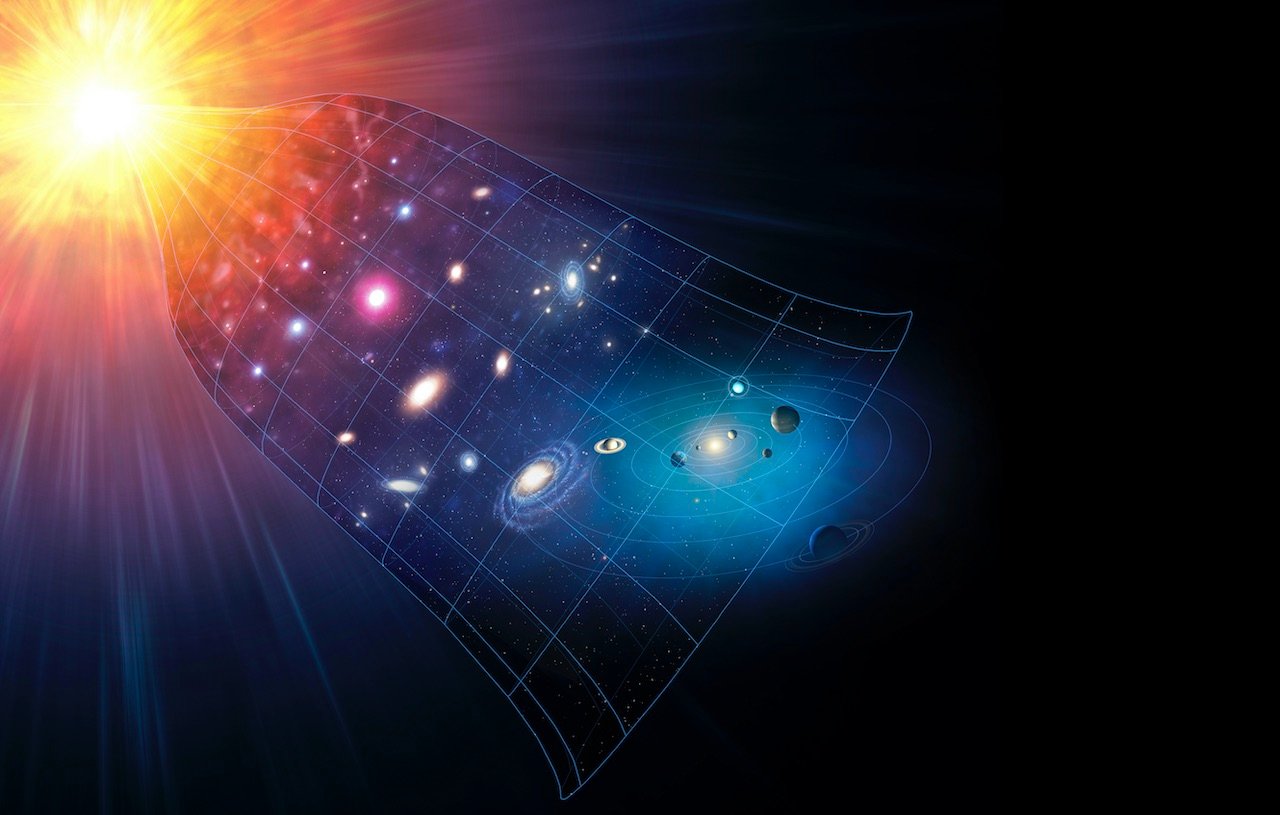
Web Desk: Modern astronomy continues to grapple with one of the most significant mysteries of the cosmos as researchers investigate why the universe is not only expanding but doing so at an accelerating rate.
The concept of cosmic expansion first gained scientific footing through the work of Edwin Hubble. He observed that distant galaxies consistently move away from one another, a discovery that provided foundational evidence for the Big Bang theory. However, the nature of this movement shifted dramatically in the late 1990s when researchers made a startling observation.
Instead of the expansion slowing down due to gravity as previously expected, scientists found that the process is actually speeding up. This breakthrough earned a Nobel Prize in Physics, yet the underlying mechanism remains largely unexplained. To address this gap, physicists proposed the existence of dark energy, a theoretical force that occupies space and pushes the universe outward.
Transitioning to current scientific challenges, the primary difficulty lies in the fact that dark energy remains invisible and undetectable by traditional instruments. While researchers calculate that it makes up the vast majority of the universe’s energy density, they still do not understand its composition or specific operational mechanics.
Consequently, teams of international astronomers are deploying new deep-space telescopes and mapping technologies to observe galaxy clusters with greater precision. By studying the history of cosmic growth, they hope to determine if dark energy is a constant property of space or a field that changes over time.
Solving this enigma stands as a top priority for the scientific community, as it dictates the ultimate fate of the universe. Until a definitive answer emerges, dark energy remains the most profound puzzle in the study of the stars.
Read more: XChat unveiled: Is this the end of WhatsApp on iPhones?