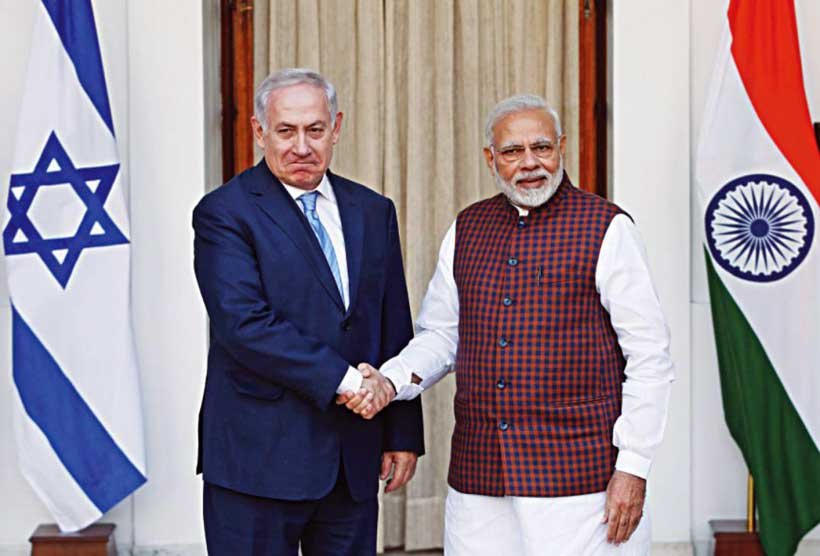
Web desk: Recent defence cooperation between India and Israel has moved beyond routine military trade. The two governments actively promote joint missile systems, air defence platforms, drone technology and intelligence sharing. However, instead of limiting cooperation to security needs, India and Israel risk projecting an aggressive alignment that deepens suspicion and intensifies geopolitical tensions.
Moreover, this framing changes how global audiences interpret the relationship. Instead of appearing as a technical defence arrangement, it now looks like a coordinated geopolitical front. Consequently, both governments benefit from presenting the partnership as a united stand against Islam and Muslims.
Netanyahu frequently describes Israel as standing at the frontline of a battle against what he calls “radical Islamic terror.” He portrays Muslims as part of a wider ideological danger to democratic societies. Furthermore, he links regional conflicts to what he defines as extremist interpretations of Islam.
This rhetoric goes beyond targeting armed groups. It blurs distinctions between violent organizations and the broader Muslim world. As a result, these remarks contribute to Islamophobic narratives. Such language deepens global polarization instead of encouraging nuanced counter terrorism cooperation.
India strengthens its defence engagement with Israel for clear strategic reasons. It seeks advanced technology, surveillance systems and missile defence capabilities to threaten Pakistan.
However, when leaders describe this cooperation as an “alliance against extremist Islam,” they transform it into a symbolic political statement. India risks aligning itself with rhetoric that alienates Muslim communities domestically and internationally.
This alliance carries heavy symbolic consequences. Over the past three years, Palestinians have endured repeated cycles of armed conflict, displacement and humanitarian crisis. Thousands of civilians, including large numbers of children, have been killed. Entire neighborhoods have been destroyed. Families continue to face shortages of food, medical supplies and safe shelter.
Consequently, when India deepens military ties with Israel, it is an indirect support for Israeli military operations. This perception fuels resentment among those who already feel abandoned by parts of the international community.
The optics of this partnership carry serious implications. Pakistan consistently advocates for Palestinian statehood and criticizes Israeli military actions. At the same time, it frames its rivalry with India within broader ideological and strategic narratives.
Therefore, statements from Israeli leadership about an “iron alliance” against extremist Islam reinforce Pakistan’s claim that the partnership marginalizes Muslim-majority nations. This perception intensifies diplomatic tensions in South Asia. Instead of easing divisions, the rhetoric risks entrenching them further.
India and Israel actively build a stronger defence partnership. Netanyahu’s rhetoric shapes perceptions far beyond Israel’s borders. Meanwhile, India’s visible alignment with Israel during a period of intense Palestinian suffering draws criticism from parts of the Muslim world.
Ultimately, this alliance deepens mistrust, intensifies regional tensions, and undermines any genuine hope for peace and reconciliation. Rather than promoting stability, India and Israel’s approach risks pushing the region further toward polarization and prolonged conflict.
Read more: India–Israel Partnership, anti-Muslim narrative further exposes